Lambeosaurus
Lambeosaurus lambei
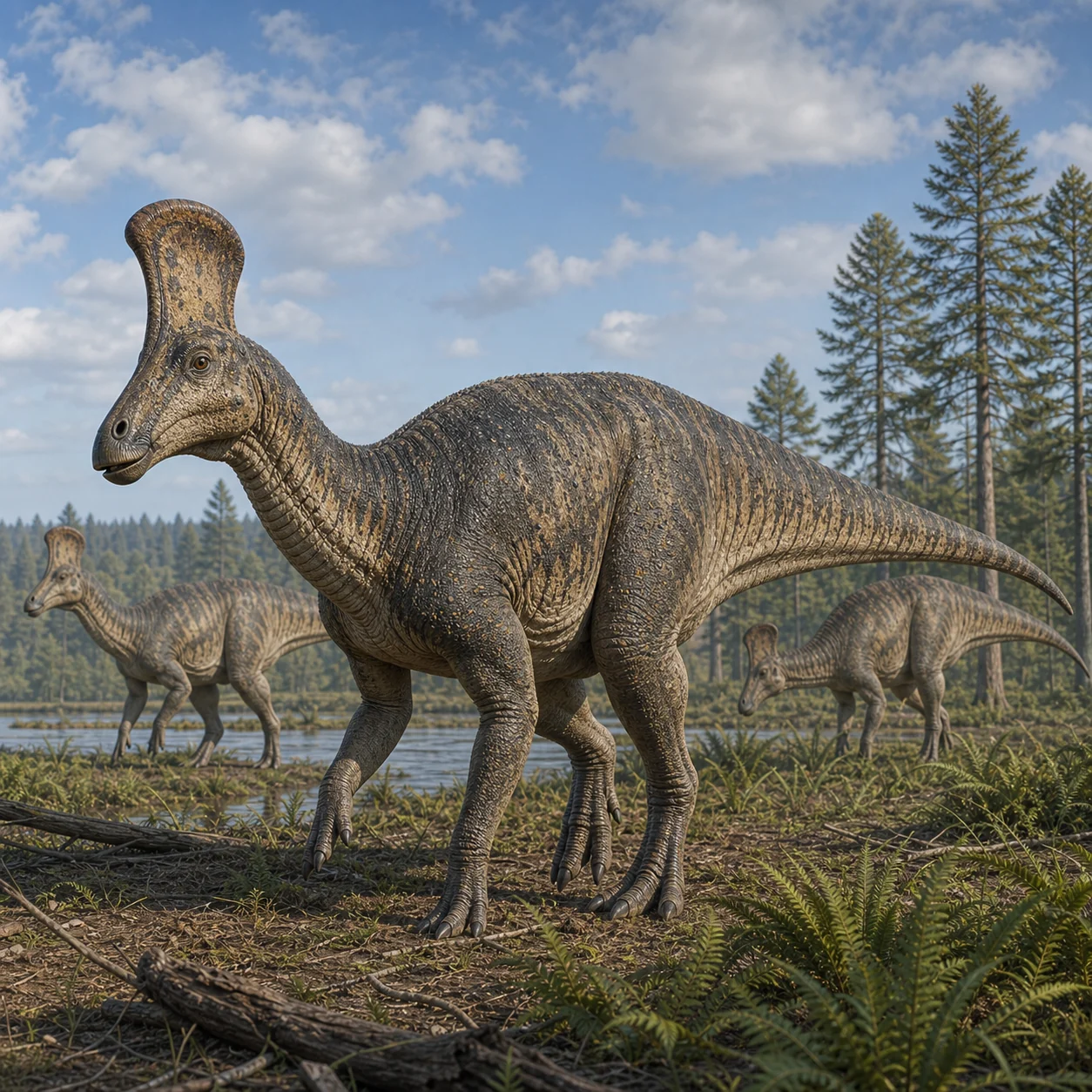
Lambeosaurus lambei possuía a crista craniana mais elaborada dos hadrossauros, em forma de machado para comunicação.
Lambeosaurus ( LAM-bee-ə-SOR-əs) is a genus of hadrosaurid dinosaur that lived during the Late Cretaceous period of western North America. The first skull of Lambeosaurus found was used by palaeontologist Lawrence M. Lambe to justify the creation of the new genus Stephanosaurus, although it was not part of the latter's original material. Its incomplete nature led William A. Parks to name Lambeosaurus lambei for this skull in 1923 to honour Lambe. Multiple species of Lambeosaurus have been named since, including L. clavinitialis and L. magnicristatus in 1935, and L. laticaudus in 1981 which was later moved to its own genus Magnapaulia. It has also been identified that some species earlier identified as belonging to Tetragonosaurus and Corythosaurus are now considered juveniles of Lambeosaurus. It is the eponymous member of the subfamily Lambeosaurinae and tribe Lambeosaurini. Lambeosaurins, which also includes Corythosaurus and Hypacrosaurus from western North America, are understood to be some of the most specialized ornithopods.
Adult Lambeosaurus would have grown to around 7–7.7 m (23–25 ft) long and weighed 2.6–3.4 t (2.6–3.3 long tons; 2.9–3.7 short tons). It was able to move on two or four legs, with a deep tail, long limbs, and a highly distinct, hollow cranial crest. This crest, which can be used to separate the three recognized species of Lambeosaurus, projects well above the eye and slightly over the snout, and adults of some species possess a backwards spur. The function of the crest, which is also found in other lambeosaurines, is debated historically, but modern studies show that it could have been used as a resonating device for vocalisation, with a secondary function of sexual or species identification.…
- Família
- Hadrosauridae
- Ordem
- Ornithischia
- Período
- Cretaceous (76.5-75.0 MYA)
- Dieta
- Herbivore
- Comprimento
- 9.0-15.0 m
- Peso
- 5.0-7.0 tons
Fatos científicos
- Crista mudava drasticamente com a idade
- Cada indivíduo tinha "assinatura vocal" única
- Maior hadrossauro da América do Norte
- Podia ficar de pé para alcançar vegetação alta
- Pele com padrão de camuflagem preservado
- Coexistia com Parasaurolophus e Corythosaurus