Protoceratops
Protoceratops andrewsi
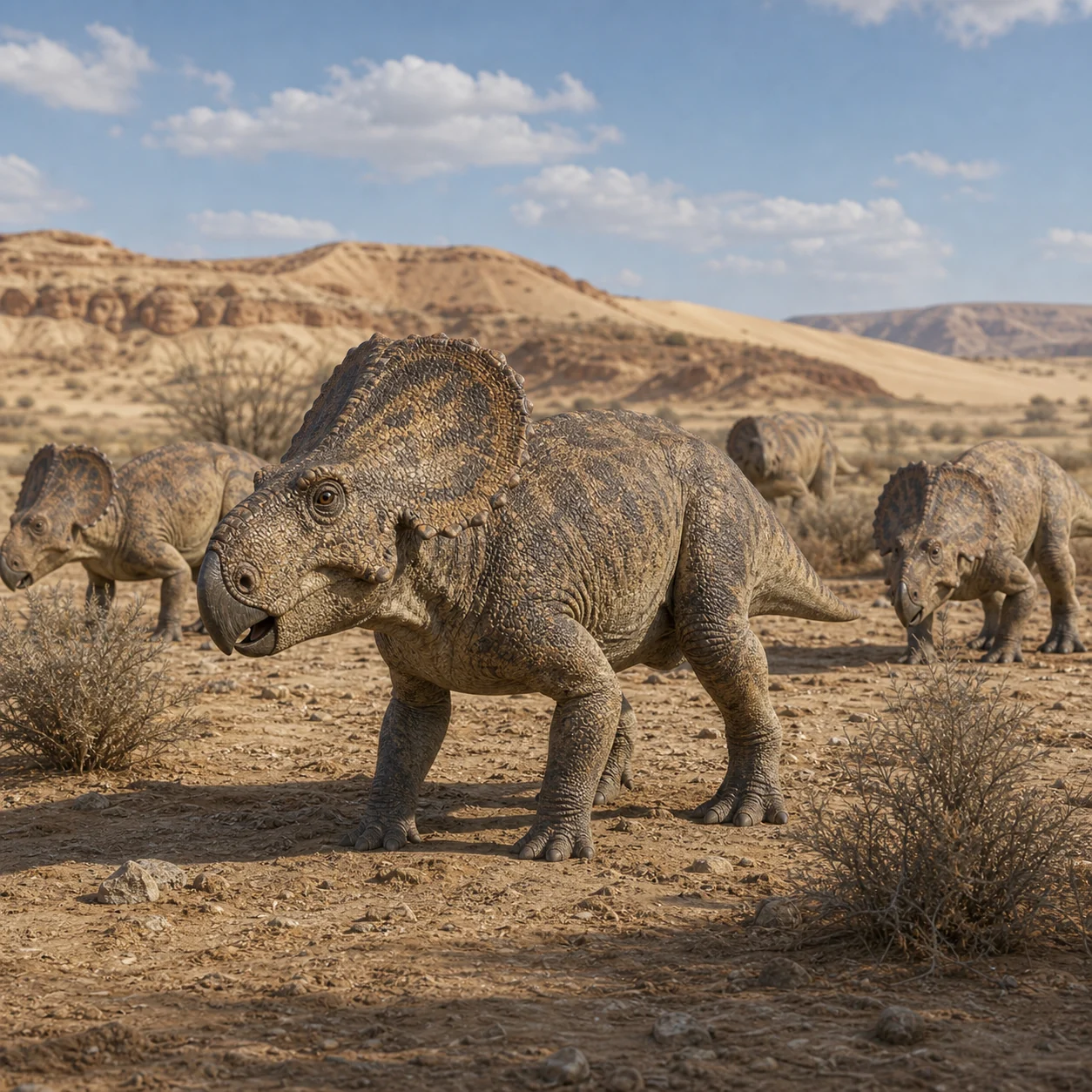
Protoceratops andrewsi foi um pequeno ceratopsiano primitivo sem chifres verdadeiros, abundante no registro fóssil mongol.
Protoceratops (; lit. 'first horned face') is a genus of small protoceratopsid dinosaurs that lived in Asia during the Late Cretaceous, around 75 to 71 million years ago. The genus Protoceratops includes two species: P. andrewsi and the larger P. hellenikorhinus. The former was described in 1923 with fossils from the Mongolian Djadokhta Formation, and the latter in 2001 with fossils from the Chinese Bayan Mandahu Formation. Protoceratops was initially believed to be an ancestor of ankylosaurians and larger ceratopsians, such as Triceratops and relatives, until the discoveries of other protoceratopsids. Populations of P. andrewsi may have evolved into Bagaceratops rozhdestvenskyi through anagenesis.
Protoceratops were small ceratopsians, up to 2–2.5 m (6.6–8.2 ft) long and around 62–104 kg (137–229 lb) in body mass. While adults were largely quadrupedal, juveniles had the capacity to walk around bipedally if necessary. They were characterized by a proportionally large skull, short and stiff neck, and neck frill. The frill was likely used for display or intraspecific combat, as well as protection of the neck and anchoring of jaw muscles. A horn-like structure was present over the nose, which varied from a single structure in P. andrewsi to a double, paired structure in P. hellenikorhinus. The "horn" and frill were highly variable in shape and size across individuals of the same species, but there is no evidence of sexual dimorphism. They had a prominent parrot-like beak at the tip of the jaws. P. andrewsi had a pair of cylindrical, blunt teeth near the tip of the upper jaw. The forelimbs had five fingers of which only the first three bore wide and flat unguals.…
- Família
- Protoceratopsidae
- Ordem
- Ornithischia
- Período
- Cretaceous (121.4-83.6 MYA)
- Dieta
- Herbivore
- Comprimento
- 1.5-2.0 m
- Peso
- 60-180 kg
Fatos científicos
- Possível origem dos mitos de grifos na Ásia Central
- Crescimento da gola correlacionado com maturidade sexual
- Ninhos com arranjo espiral de ovos
- Bico forte para vegetação dura do deserto
- Dimorfismo sexual no tamanho e forma da gola
- Abundância sugere sucesso em ambiente árido