Pteranodon
Pteranodon longiceps
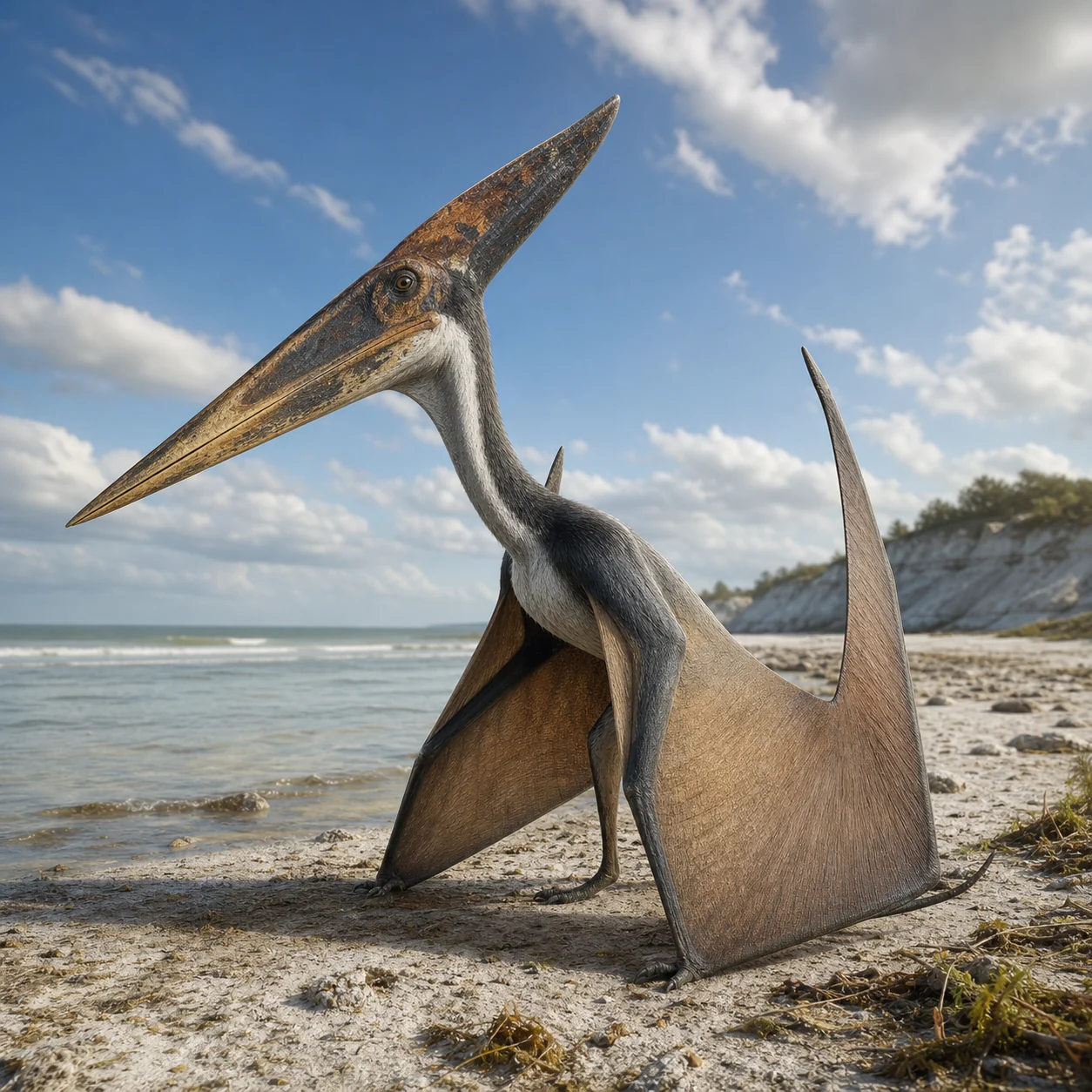
Pteranodon (; from Ancient Greek pteron 'wing', an- 'without', and odon 'tooth' is a genus of pterosaur that included some of the largest known flying reptiles, with P. longiceps having a wingspan of over 6 m (20 ft). They lived during the late Cretaceous geological period of North America in present-day Kansas, Nebraska, Wyoming, South Dakota and Alabama. More fossil specimens of Pteranodon have been found than any other pterosaur, with about 1,200 specimens known to science, many of them well preserved with nearly complete skulls and articulated skeletons. It was an important part of the animal community in the Western Interior Seaway.
When the first fossils of Pteranodon were found, they were assigned to toothed pterosaur genera, which includes Ornithocheirus and Pterodactylus. In 1876, Othniel Charles Marsh recognised it as a genus of its own, making particular note of its complete lack of teeth, which at the time was unique among pterosaurs. Over the decades, multiple species would be assigned to Pteranodon, though today, only two are recognised: P. longiceps, the type species, and P. sternbergi. A third species, P. maiseyi, may also exist. Some researchers have suggested the latter two as a genus of their own, Geosternbergia, though this is the subject of some debate. Another genus split from Pteranodon, Dawndraco, may be synonymous with Geosternbergia if that genus is valid, or with Pteranodon if it is not.
Pteranodon is part of the family Pteranodontidae, part of the clade Pteranodontia, which also includes nyctosaurids. Pteranodontians form a larger clade, Pteranodontoidea, alongside ornithocheiromorphs, and that clade falls under the suborder Pterodactyloidea.…
- Family
- Pteranodontidae
- Order
- Pterosauria
- Period
- Cretaceous (88.0–80.5 Ma)
- Diet
- Carnivore
- Length
- 6.0–7.0 m wingspan
- Weight
- 20–93 kg
- Type locality
- Niobrara Formation, Kansas, USA
- Holotype
- YPM 1177
- PBDB
- txn:38502