Lurdusaurus
Lurdusaurus arenatus
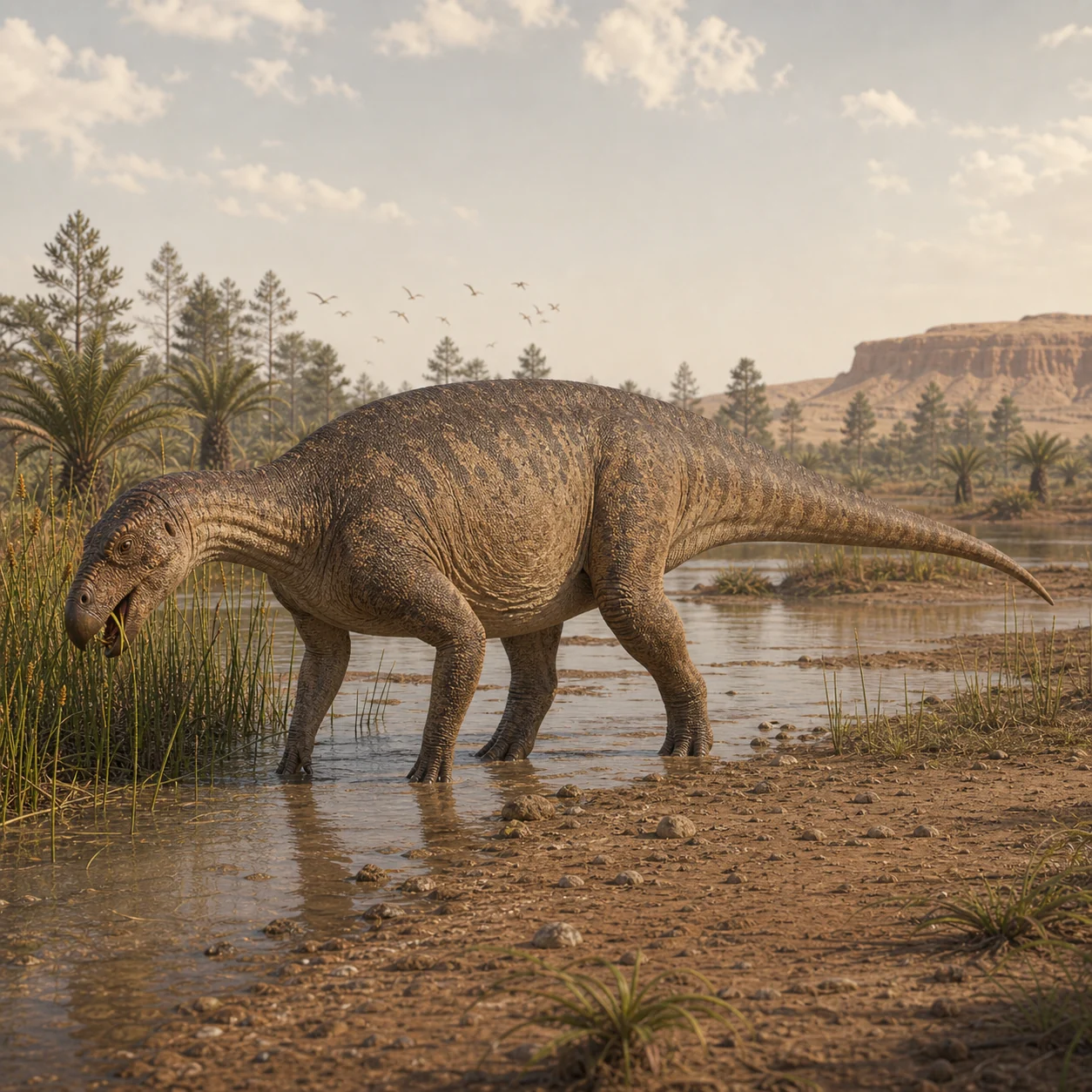
Lurdusaurus ("heavy lizard") is a genus of massive and unusually shaped iguanodont dinosaur from the Elrhaz Formation in Niger. It contains one species, L. arenatus. The formation dates to the Early Cretaceous, roughly 112 million years ago.
Lurdusaurus has a highly atypical body plan for an iguanodont, with a small skull, long neck, rotund torso, and powerful forelimbs and claws (the thumb-spike is remarkably enormous), somewhat reminiscent of a ground sloth. Lurdusaurus is estimated to have been 7–9 m (23–30 ft) long and 2 m (6 ft 7 in) high when on all-fours, but its stomach would have been only 70 cm (2 ft 4 in) off the ground. It may have weighed 2.5–5.5 t (2.8–6.1 short tons), conspicuously heavy for an iguanodontid this size. Correspondingly, Lurdusaurus may be the first ornithischian identified with graviportal anatomy, designed for moving slowly whilst supporting a heavy body mass.
Paleontologist Thomas R. Holtz Jr. speculated Lurdusaurus may have behaved much like a hippo. It lived in a forested, riverine environment alongside the iguanodonts Elrhazosaurus and Ouranosaurus, the sauropod Nigersaurus, an undescribed titanosaurid, the spinosaurid Suchomimus, the carcharodontosaurid Eocarcharia, the abelisaurid Kryptops, and the noasaurid Afromimus. The site also yielded several crocodylomorph species and a pterosaur.
- Family
- Iguanodontidae
- Order
- Ornithischia
- Period
- Cretaceous (110 Ma)
- Diet
- Herbivore
- Length
- 9.0 m
- Weight
- 5 t
- Type locality
- Agadez, Niger
- Holotype
- MNHN GDF 1700
- PBDB
- txn:64410