Ceratosaurus
Ceratosaurus nasicornis
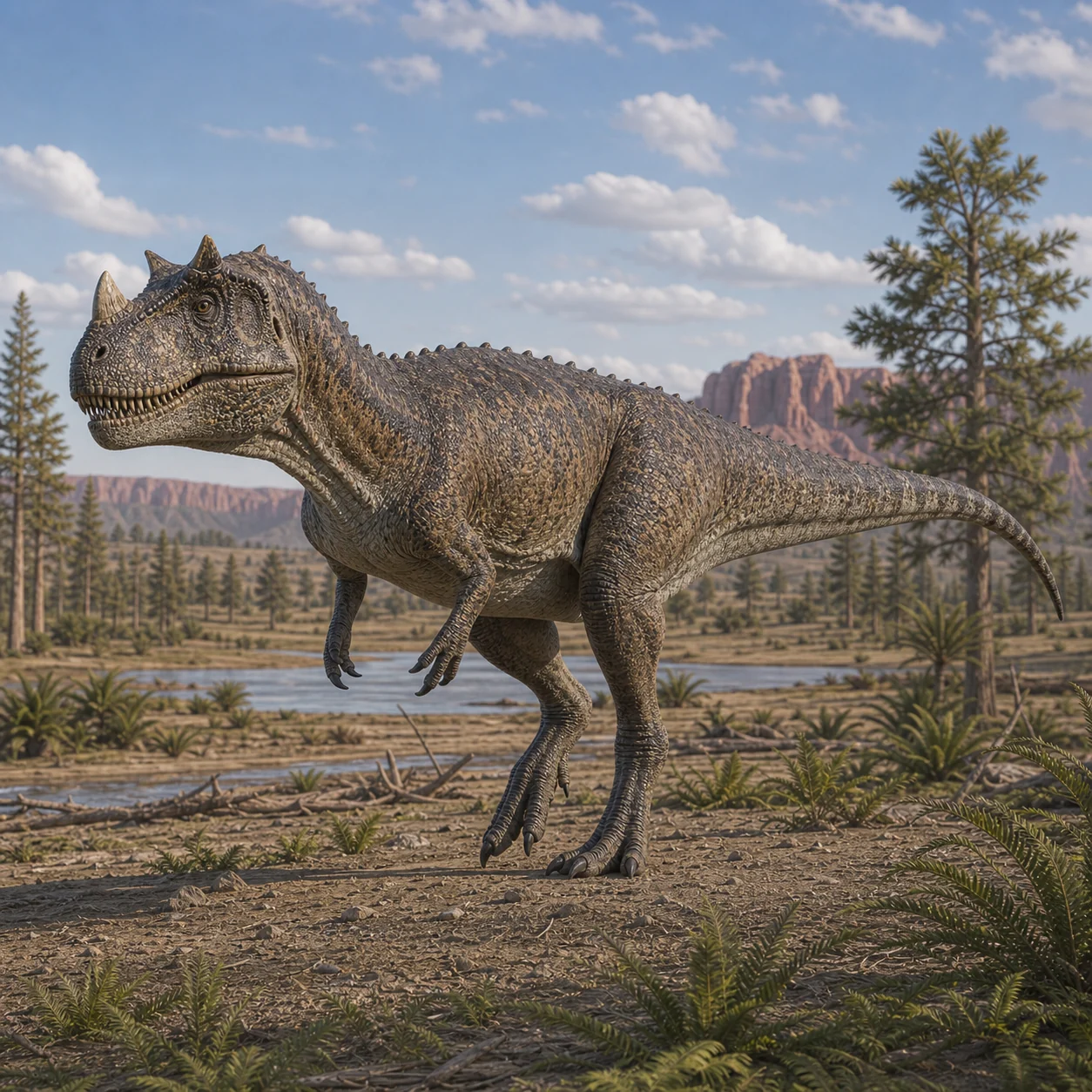
Ceratosaurus (from Greek κέρας / κέρατος keras / keratos 'horn' and σαῦρος sauros 'lizard') is a genus of carnivorous theropod dinosaur that lived during the Late Jurassic period (around 155 m.y.a) in North America and Europe . The genus was first described in 1884 by American paleontologist Othniel Charles Marsh based on a nearly complete skeleton discovered in Garden Park, Colorado, in rocks belonging to the Morrison Formation. The type species is Ceratosaurus nasicornis.
The Garden Park specimen remains the most complete skeleton known from the genus and only a handful of additional specimens have been described since. Two additional species, Ceratosaurus dentisulcatus and Ceratosaurus magnicornis, were described in 2000 from two fragmentary skeletons from the Cleveland-Lloyd Quarry of Utah and from the vicinity of Fruita, Colorado. These species are no longer accepted by most paleontologists, and all three skeletons possibly represent different growth stages of the same species. In 1999, the discovery of the first juvenile specimen was reported. In 2000, a partial specimen was excavated and described from the Lourinhã Formation of Portugal, providing evidence for the presence of the genus outside of North America. Fragmentary remains have also been reported from Tanzania, Uruguay, and Switzerland, although their assignment to Ceratosaurus is currently not accepted by most paleontologists.
Ceratosaurus was a medium-sized theropod. The original specimen is estimated to be 5.3 m (17 ft) or 5.69 m (18.7 ft) long, while the specimen described as C. dentisulcatus was larger, at around 7 m (23 ft) long.…
- Family
- Ceratosauridae
- Order
- Saurischia
- Period
- Jurassic (156.3–145.0 Ma)
- Diet
- Carnivore
- Length
- 5.5–7.0 m
- Weight
- 500–1000 kg
- Type locality
- Morrison Formation, Colorado, USA
- Holotype
- USNM 4735
- PBDB
- txn:38600